
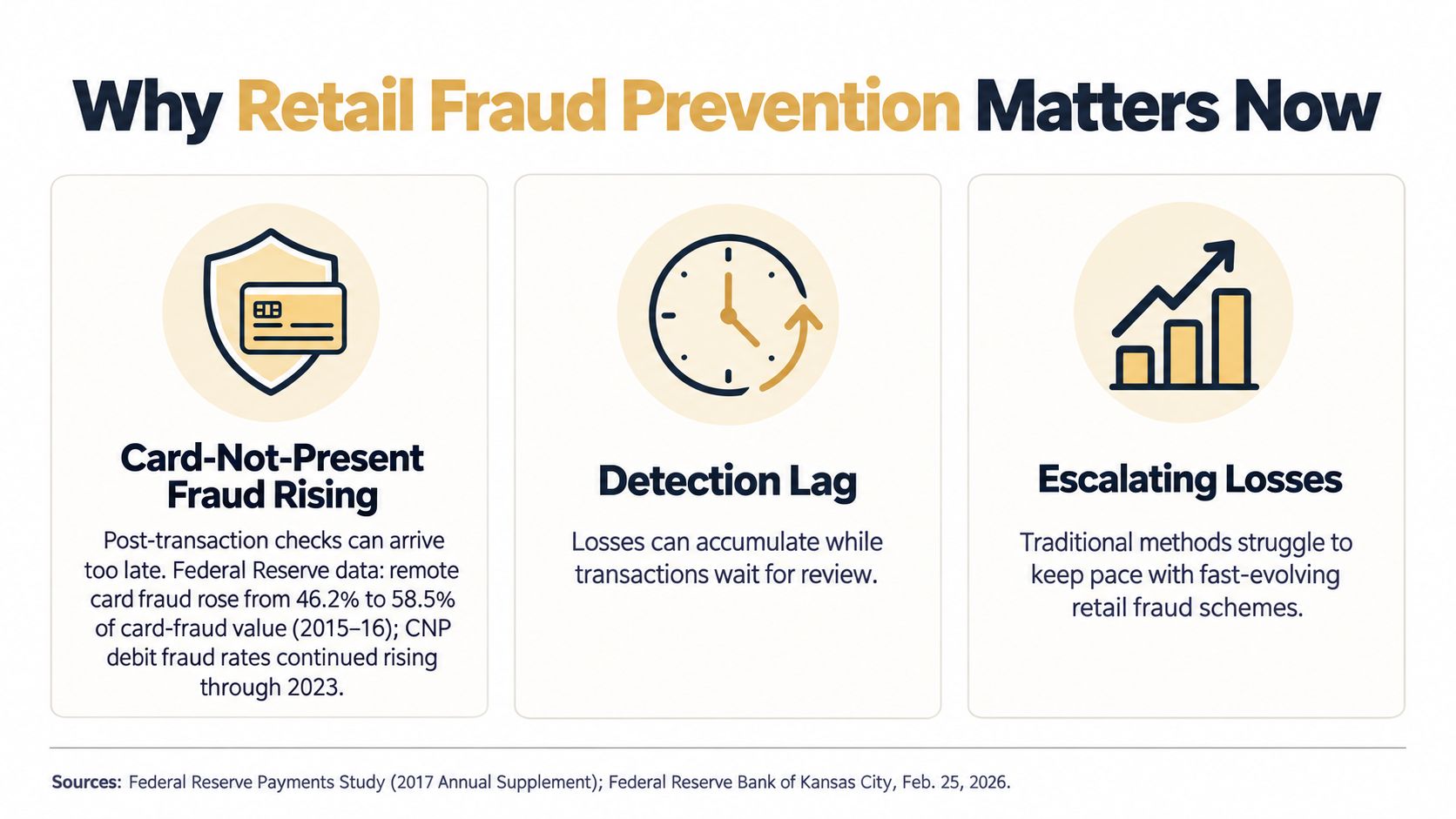
Card-not-present fraud represented 54.3% of total fraud losses in 2023, and merchants absorbed 49.9% of losses. That's why retail fraud prevention has to happen before payment capture, not after the chargeback lands.
Retailers can't treat fraud as a single checkout problem anymore. The same abuse patterns now show up across signup, trial, login, purchase, and return flows, and the weak point is usually the gap between those systems.
Table of Contents
- Why Retail Fraud Prevention Matters Now
- The Three Primary Fraud Vectors in Retail
- Building an Abuse Graph Across Events
- Deterministic Verdicts vs Opaque Risk Scores
- Fraud Scenarios and How Integrated Screening Catches Them
- The Case for Unified Inline Screening at Scale
- An Integration Playbook for Signup, Trial, Checkout, and Login
- Beyond Payment Fraud The Returns Abuse Reality
Why Retail Fraud Prevention Matters Now
The Federal Reserve's 2023 numbers change the operating assumption. Card-not-present fraud made up the largest share of total fraud losses, while merchants carried nearly half of the financial burden, and even more in card-not-present fraud specifically, where merchants absorbed 65.1% of losses (Federal Reserve data). That combination matters because it pushes loss from the issuer's side into the retailer's margin, fulfillment cost, and customer-service queue.
A payment approval is not a legitimacy check. It only tells you the issuer approved the transaction, not that the buyer, device, account, shipping pattern, or intent are clean. If your only hard stop is the chargeback process, you're paying for fraud twice, once in operational work and again in avoidable loss.
Practical rule: the earlier you decide, the cheaper the failure.
That is the reason deterministic screening belongs at checkout and before fulfillment. A unified control layer can evaluate device continuity, payment artifacts, identity history, and transaction behavior in one pass, then separate clean traffic from suspicious traffic before inventory moves or digital access is granted.
Post-transaction review still has a place, but it's a cleanup function, not a primary defense. If you want a deeper technical view of inline decisioning, this overview of e-commerce fraud detection is a useful companion read.
The Three Primary Fraud Vectors in Retail
Retail fraud doesn't move through one doorway. It usually enters through payment abuse, return abuse, or physical point-of-sale compromise, and each one behaves differently at the edge of the business.
Payment abuse is the most familiar to online teams. It includes card testing, account cycling, stolen payment artifacts, and checkout attempts that look normal at the surface but repeat across devices, wallets, or delivery patterns. The important detail is that payment abuse rarely stays isolated to one cart.
Return abuse sits later in the journey, which is why it gets underestimated. It can include wardrobing, fake item returns, policy manipulation, and organized refund schemes that exploit convenience. The digital trace often begins long before the return label is printed, in the original account behavior, the item mix, or the timing of the request.
POS attacks are the physical counterpart. They show up as tampering, social engineering at checkout, misuse of employee permissions, or fraud that starts in-store and finishes online through a refund or exchange path. The store associate may see a routine transaction, while the fraud system sees only the aftermath unless signals are connected.
The shared weakness across all three is traceability. Each vector leaves artifacts in identity, device, payment, and timing data, which means retailers can map threat types to control points instead of reacting blindly after the loss occurs.
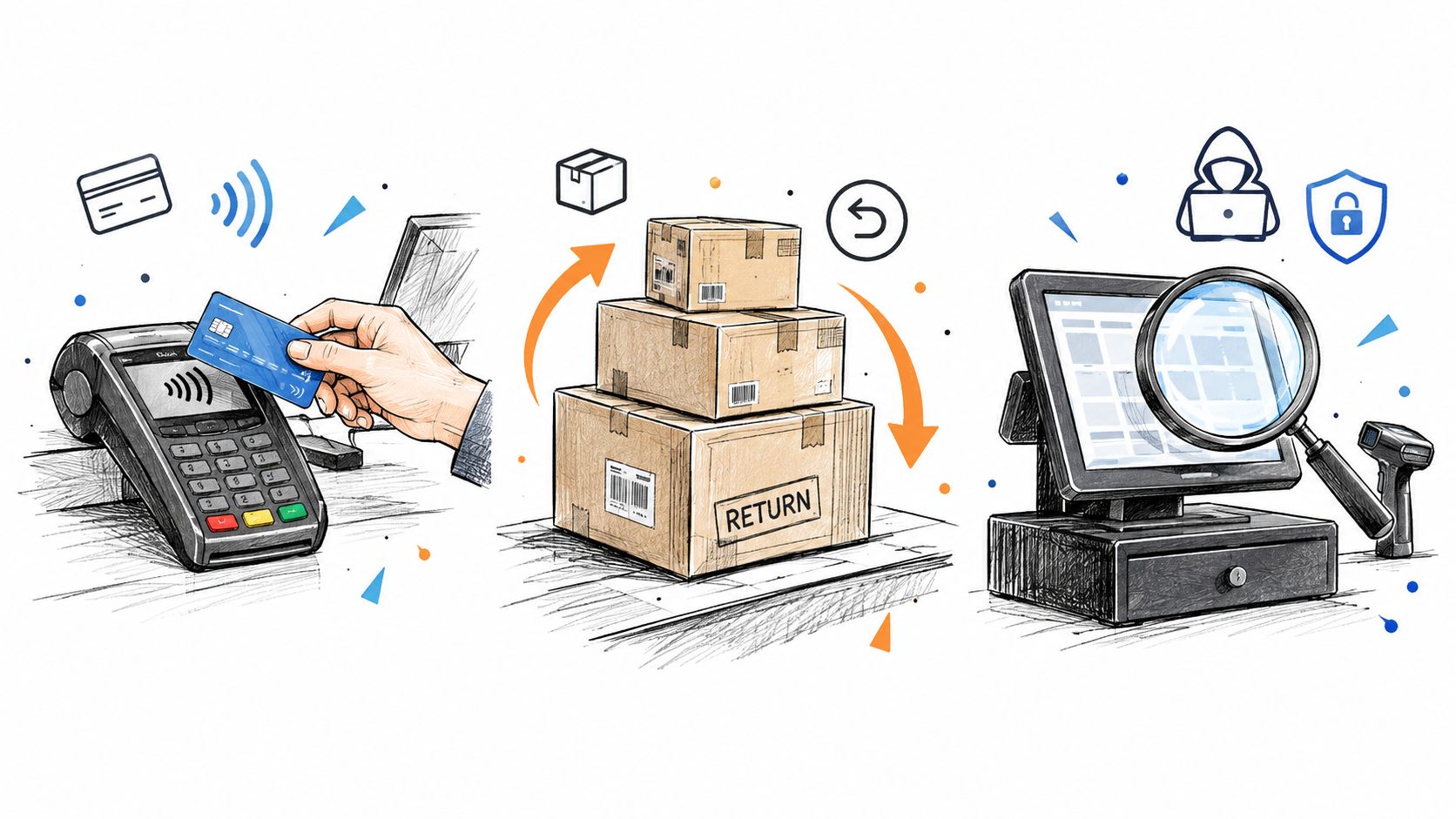
When teams separate these vectors into different tools and queues, they also split the context that makes pattern recognition possible. That's why retail fraud prevention works better as a shared decision layer than as three disconnected cleanup processes.
Building an Abuse Graph Across Events
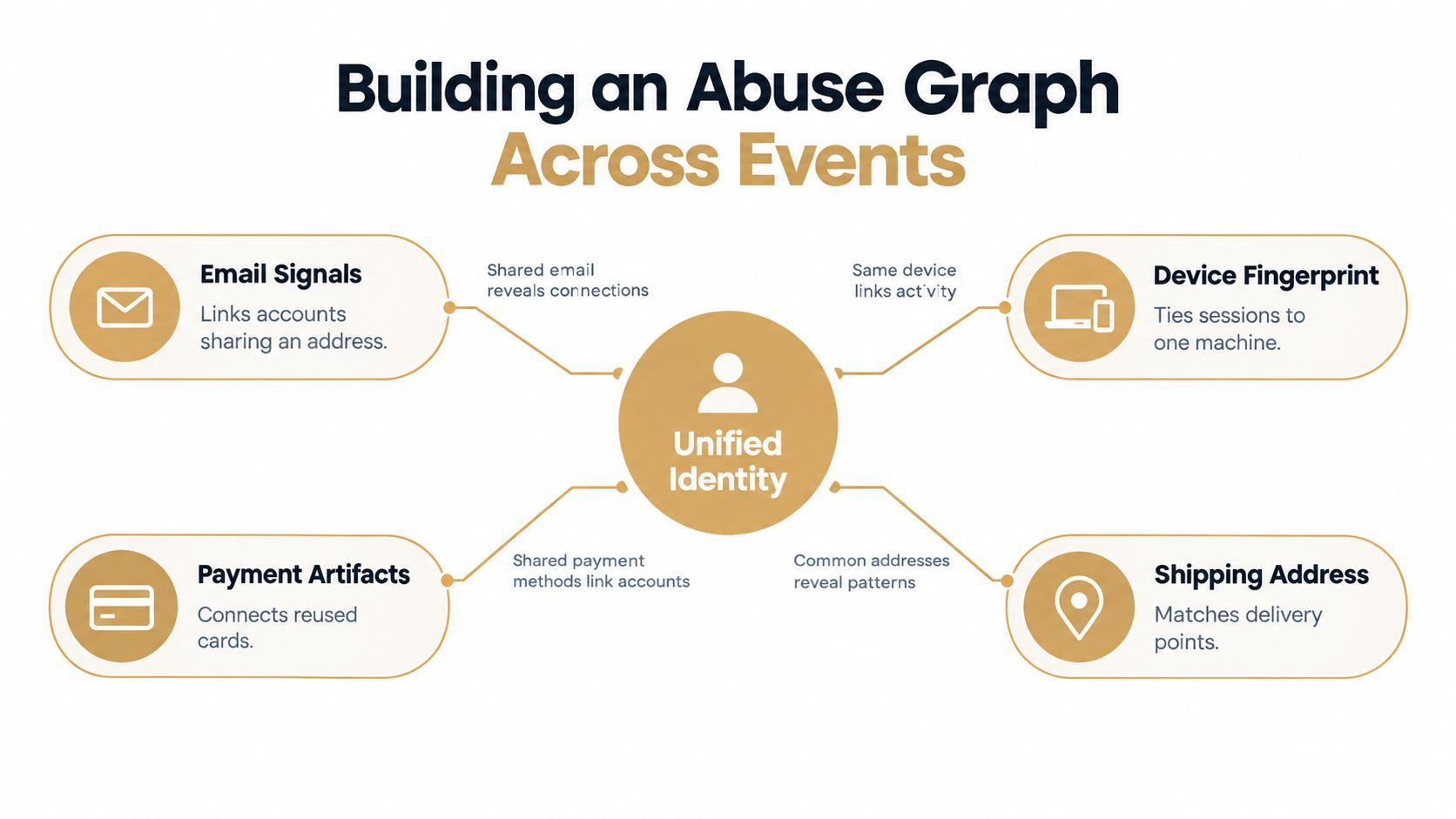
Fraud detection gets much stronger once the same identity can be recognized across separate events. A persistent abuse graph does that by linking emails, device fingerprints, card fingerprints, payer wallets, and shipping relationships into one memory of behavior instead of one-off checks.
Why linked events matter more than isolated signals
An email address can change. A phone number can change. A disposable inbox can appear and disappear in minutes. But when the same device, wallet, or payment artifact shows up again, the pattern becomes visible even if the surface identifiers are new.
That's also why IP addresses shouldn't be your core identity key. They're useful context, but they're too noisy and too shareable to carry the weight of primary linkage. A stronger model hashes identity keys, scopes them per tenant, and keeps the linkage inside a controlled abuse graph, which preserves privacy while still letting the system see repetition.
Linked behavior is more important than any one attribute.
Cluster marking is what turns that graph into an operational advantage. Once a pattern is confirmed as abuse, related identities and devices can inherit that signal, which stops the same actor from getting a fresh start with every new account or trial. That persistent memory lowers manual review churn because investigators don't have to rediscover the same bad actor in every queue.
For teams that already think in linked-risk terms, AML-style fraud detection patterns translate well to retail, especially when you're trying to connect seemingly separate actions into a single behavioral cluster.
Deterministic Verdicts vs Opaque Risk Scores
Fraud teams often inherit scoring systems that create more interpretation work than they remove. A score may tell you something is risky, but it still leaves the reviewer to decide what to do next, which slows the queue and makes outcomes inconsistent across analysts.
Deterministic verdicts are cleaner because they answer the operational question directly. Allow, review, or block, with reason codes attached, gives the analyst a decision boundary and gives engineering a policy boundary. That matters when the cost of a false decline is lost revenue and the cost of a missed fraud case is direct margin loss.
Decision Frameworks Compared
| Aspect | Deterministic Verdicts | Opaque Risk Scores |
|---|---|---|
| Output | Clear allow, review, or block action | Numeric or abstract score that needs interpretation |
| Analyst speed | Faster triage because the next step is obvious | Slower, because humans translate the score into action |
| Auditability | Stronger, because the reason code and outcome are explicit | Weaker, because the decision path can be hard to reconstruct |
| Consistency | Higher across teams and shifts | Lower when different reviewers interpret scores differently |
| Tuning | Easier to calibrate against false declines and chargebacks | Harder to connect a score threshold to a specific business policy |
The biggest practical difference is memory depth. A single engine with configurable memory can recognize repeated behavior across time, while fragmented tools only see the slice they were asked to inspect. That makes the review process less about guessing and more about applying policy consistently.
Fraud Scenarios and How Integrated Screening Catches Them
The cleanest way to understand unified screening is to watch it catch abuse at the moment the actor expects a pass. A card tester isn't usually trying to place one valuable order. They're probing for valid payment combinations and looking for systems that don't connect one attempt to the next.
At checkout, the important clues are repeated payment artifacts, device continuity, and velocity. If the same device keeps surfacing with new cards or new accounts, the pattern is no longer a coincidence. A linked-identity layer can block high-confidence matches, route ambiguous traffic to review, and preserve evidence for later action.

A burner-email scheme looks different on the surface but follows the same logic. The account name changes, the inbox changes, and the signup details may be synthetic, yet the device or payment relationship often repeats. That's where persistent cluster marking matters, because it prevents the actor from resetting the risk history by swapping a single field.
A return fraud ring is the late-stage version of the same problem. One member may place the order, another may generate the return, and a third may exploit policy loopholes or item movement. If the platform keeps event history together, the return request doesn't look like an isolated customer service case, it looks like the next step in a known cluster.
The value of integrated screening is that it catches the actor before the story fragments across teams. Fraud, support, and risk all see the same evidence chain, which means the response can be faster and far more defensible.
The Case for Unified Inline Screening at Scale
Siloed tooling creates blind spots at the exact moment a retailer needs continuity. Signup, trial, login, checkout, and post-purchase events are all part of the same abuse lifecycle, so splitting them across disconnected systems forces your team to reassemble the truth after the fact.
Integrated inline screening works because it moves the decision to the edge of the event. One policy engine can gate new accounts, trial starts, trial conversions, checkout attempts, and logins before the action commits, which reduces the amount of cleanup work that follows. It also keeps evidence in one place, so the investigator doesn't have to jump between a payment console, a support inbox, and a separate fraud dashboard.
Operational advantage: one decision layer reduces the cost of context switching.
The ACFE finding that tips detected 43% of occupational-fraud cases supports the same operational idea, because human reports are most useful when they feed into the same linked-identity workflow as machine-detected signals (ACFE). A customer complaint, a support escalation, or a store report shouldn't sit in a separate bucket if it can strengthen a cluster already under review.
That's also where inline screening can support other retail layers without multiplying friction. If the same engine can screen repeated trial abuse, checkout abuse, and suspicious login activity, you avoid building separate rulesets that drift apart over time. Portreeve is one example of that design, since it returns an allow, review, or block verdict before the action commits and keeps linked history in one abuse graph.
An Integration Playbook for Signup, Trial, Checkout, and Login
Wire screening into the five events where abuse becomes expensive: signup, trial start, trial convert, checkout attempt, and login. At those points, a delay or a bad decision creates real cost, either in fraud loss, manual cleanup, or avoidable customer friction.
Send the event to a verdict API before the action is finalized, then let the response allow it, route it for review, or block it. SDKs and webhooks handle the handoff back into the product, while the decision workspace keeps the evidence trail in one place for analysts.
What to operationalize first
- Event gating: Put the decision call before account creation, payment capture, or access grant.
- Review queue design: Send only ambiguous cases to analysts so the queue stays workable and the highest-risk patterns get attention first.
- Reason-code calibration: Track why a case was blocked or reviewed, then compare that with chargebacks, false declines, and approved-good traffic.
- Memory depth: Start with the shortest retention that still captures repeat abuse, then extend it if serial actors keep resurfacing.
- Outcome logging: Keep the verdict and the later outcome together so threshold tuning stays evidence-driven.
Latency and certainty pull in different directions. If the decision returns quickly enough to stay inline, customer experience holds up while risk stays controlled. If the system cannot decide confidently, review is the safer choice than forcing a hard block on weak evidence.
The operating goal is fast, consistent decisioning with enough history to stop repeat abuse and enough transparency to tune policy without guesswork. Portreeve follows that model, returning an allow, review, or block verdict before the action commits and keeping linked history in one abuse graph.
Beyond Payment Fraud The Returns Abuse Reality
Return fraud is often treated like a single, messy category, and that's exactly why blanket friction performs so poorly. The more useful frame is risk segmentation, because the evidence points to a small group of shoppers carrying a disproportionate share of the risk, while most customers remain legitimate and should not be punished for it (Happy Returns).
A segmented approach starts with identity-linked history, item value, return method, timing, and network relationships. That combination is stronger than blunt refund rules because it separates one-off mistakes from repeated, coordinated behavior. It also gives teams a way to apply extra review only where the evidence supports it.
Retailers also have to adjust for how return abuse is changing. Social learning and generative AI make claim patterns easier to copy, which means static policies can miss coordinated wording, timing, or escalation tactics. A model that leans on device continuity, payment artifacts, and connected accounts is harder to game than one that relies on form text alone.
For teams building a broader returns control stack, Portreeve's returns fraud overview is a useful reference point for connected risk and review design.
Regional testing matters too. Abuse exposure and consumer behavior vary by market, so a control that feels reasonable in one geography can create too much friction in another. The right response is selective friction, not universal suspicion.
If you're building retail fraud prevention across signup, checkout, login, and returns, Portreeve can help you screen those events in one inline layer with allow, review, and block decisions plus linked history. Visit Portreeve to see how a unified abuse graph and fast verdicting can fit into your stack.